
How Stan Integrated Gemini & Veo 3 to Build Smarter Live Experiences
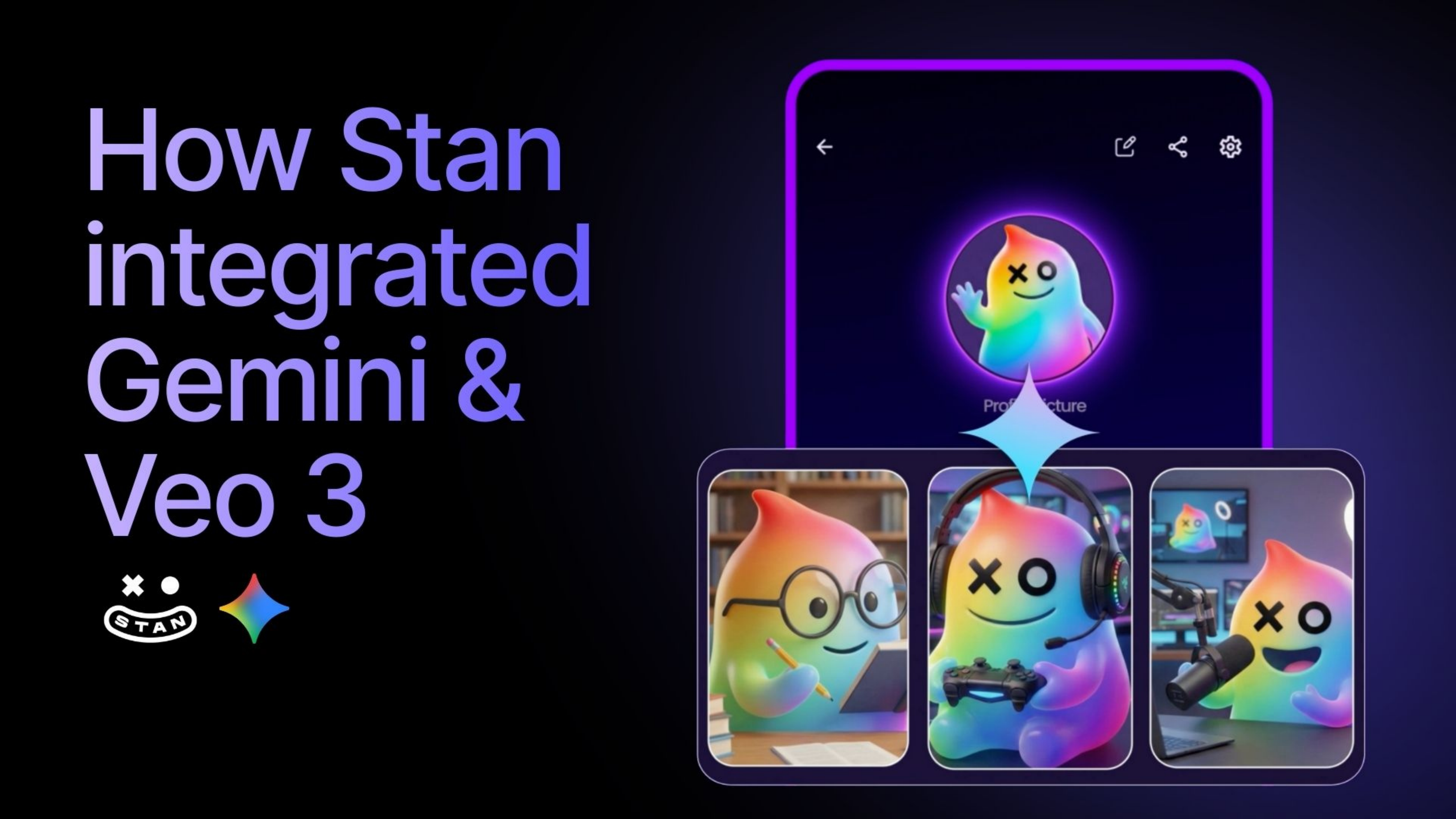
Stan’s integration with Google’s Gemini and Veo 3 AI stack
Stan is India’s leading live audio and gaming community platform, home to thousands of creators hosting live clubs across gaming, lifestyle, comedy, and more. As the platform scales, one question keeps surfacing: how do you ensure quality, safety, and growth—simultaneously—without drowning in manual operations?
The answer: a deep, end-to-end integration with Google’s Gemini 2.5 and Veo 3 AI models. This blog walks through four key systems Stan has built on top of this partnership, each solving a distinct challenge in the live-audio ecosystem.
1. The Creator Feedback Loop (Reinforcement Engine)
Most platforms treat creator coaching as a luxury—reserved for top performers with dedicated account managers. Stan flips that model entirely. Using Gemini, every single creator on the platform now gets an AI-powered coach.
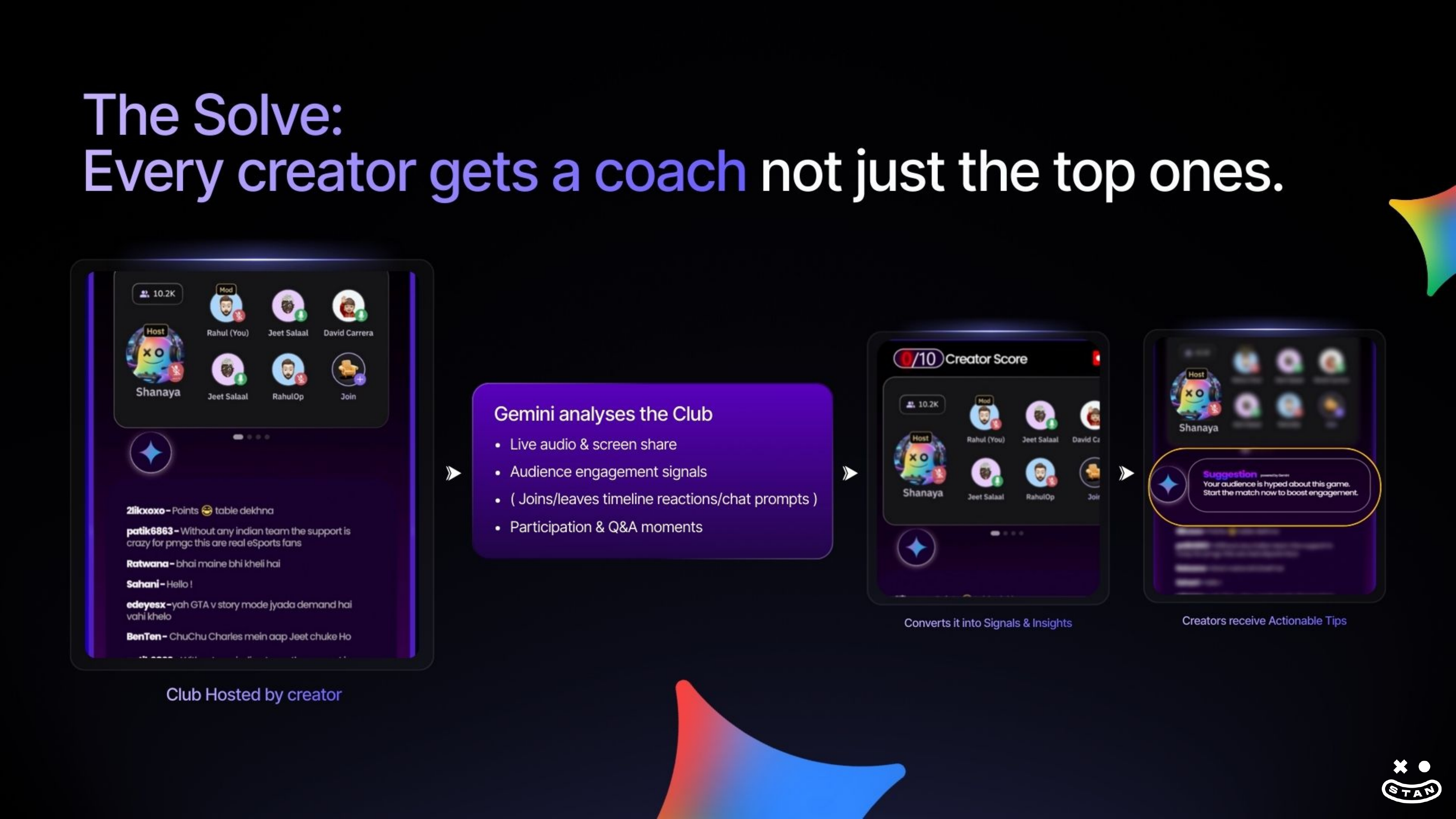
Every creator gets a coach, not just the top ones—Gemini analyses each club in real time
The Problem
Creators hosting live clubs had no structured way to know what worked and what didn’t. They relied on intuition, coaching didn’t scale, and the same mistakes were repeated across sessions. Without a feedback loop, improvement was slow and inconsistent.
How It Works
After every club session, Stan’s AI ingests the full session context: live audio recordings, screen share data, and granular engagement events such as join/leave timelines, reactions, chat prompts, and speaker changes. Gemini processes this into two layers:
- Structured Signals: Quantified scores for energy and enthusiasm, voice clarity, audience engagement curves, responsiveness to questions, topic handling depth, and facilitation flow.
- Human-Readable Insights: Actionable coaching tips like “Your energy peaked in the first 10 minutes—retention was highest there” or “You spoke continuously for 8 minutes; audience participation dipped. Add a prompt every 2–3 minutes.”
The Reinforcement Layer
This isn’t one-off feedback. Stan compares each new session against a creator’s history using a recency-weighted scoring model. Recent sessions carry more weight, so improvement is rewarded quickly. If a suggestion was ignored repeatedly, Stan nudges again—more specifically each time. The result is a true reinforcement loop: measure, coach, track, re-coach.
Impact
Stan reports 37% higher average engagement per session, an 8% increase in creator income, and creator onboarding time slashed from 48 hours to just 10 minutes. Improvement cycles shifted from weekly reviews to real-time, post-session feedback.
Creator ELO: Dynamic Reputation Scoring
Complementing the feedback loop is Creator ELO—a live reputation score based on how audiences actually respond, not follower count. New creators host their first few clubs, AI measures real performance and audience response, and a dynamic rating is assigned. This powers discovery ranking, cohort matching, and fast-track onboarding for high-performing newcomers.
2. AI-Driven Marketing Creative Generation (Veo 3 + Gemini)
User acquisition in India’s hyper-competitive mobile market demands constant creative iteration—across languages, regions, and cultural vibes. Stan’s marketing team was spending most of their time making content instead of learning from it.
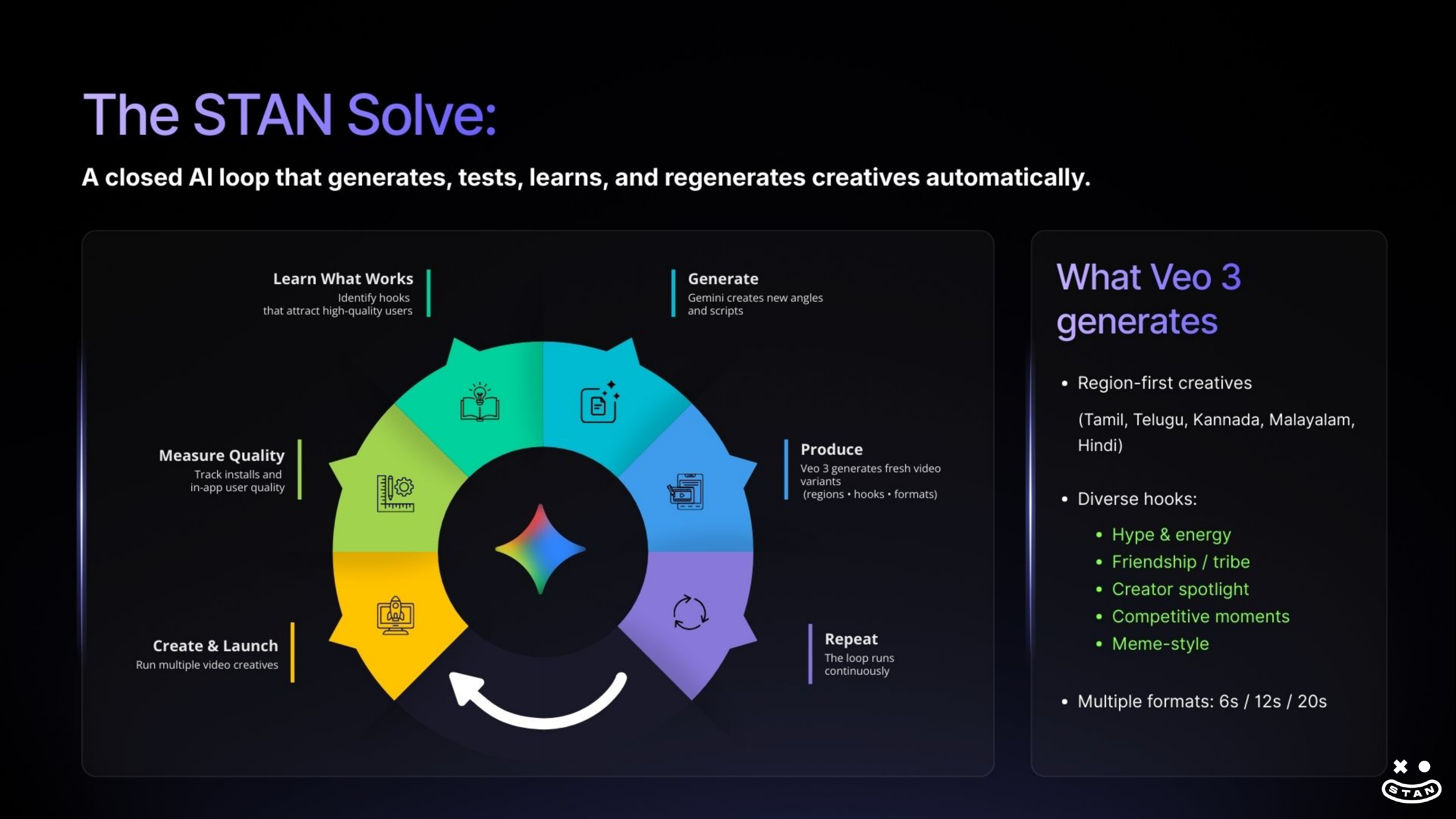
The STAN Solve: a closed AI loop that generates, tests, learns, and regenerates creatives automatically
The Problem
Brainstorming started from scratch every campaign. Creative bandwidth was limited across regions and formats. Campaigns optimized for install volume but not user quality. Learning cycles were slow and manual.
The Closed AI Loop
Stan built a self-reinforcing creative engine. The system runs multiple creatives, then measures not just installs but downstream quality: did the user complete onboarding? Join a club? Return the next day? Follow a creator? The AI identifies which themes and hooks attracted quality users, generates new video prompts for Veo 3, produces regional variants, and repeats.
What Veo 3 Generates
Region-first creatives spanning Tamil, Telugu, Kannada, Malayalam, and Hindi. Multiple hook styles—hype/energy, friendship/tribe, creator spotlight, competitive gaming moments, and meme-style. Multiple lengths at 6s, 12s, and 20s formats. The system balances exploitation of proven winners with exploration of new angles automatically.
Impact
A 90% reduction in creative production time across ideation, scripting, and variant generation. Customer acquisition cost reduced by 5%, with stronger local-event-driven growth and quantifiable experimentation at scale.
3. Real-Time Safety & Moderation (Regional Languages)
Live audio at scale presents a unique safety challenge. Rooms grow fast, issues need to be caught in the moment, and harassment isn’t always obvious—especially when it’s expressed through regional languages, slang, code-mixing, tone, and sarcasm.
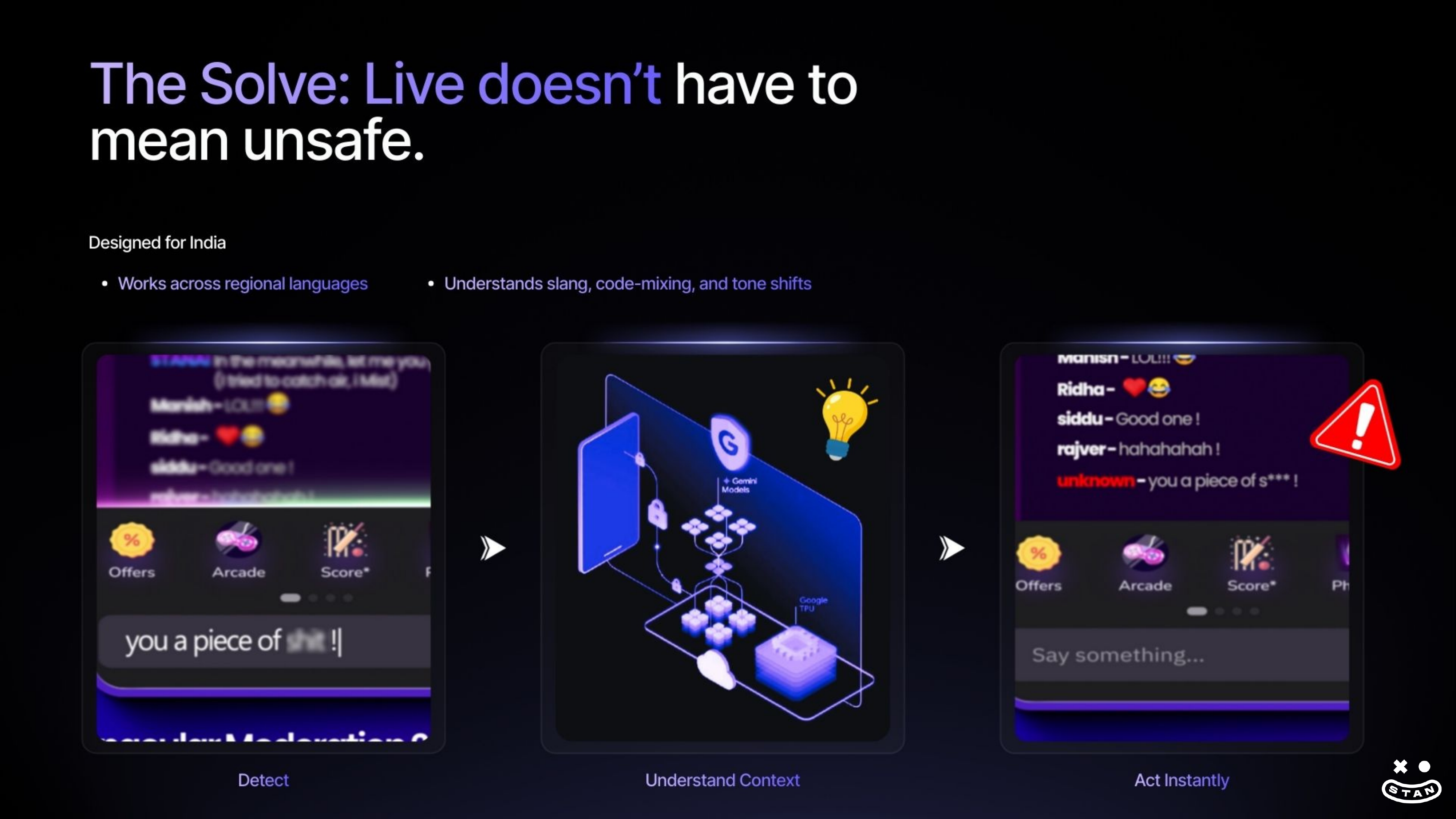
Detect → Understand Context → Act Instantly—designed for India’s multilingual live rooms
The Challenge
Manual moderation simply can’t keep pace with the speed, volume, and language diversity of live audio rooms. Stan needed a system that could detect toxic content, understand context and intent, and act instantly.
How It Works
Stan’s moderation system operates in three layers. First, detection: identifying toxic language, harassment, sexual content, threats, and grooming patterns. Second, contextual understanding: going beyond keywords to assess intent, tone, escalation patterns, and repeated behavior. Third, action: warnings, restrictions, escalation to human moderators, or session termination in extreme cases.
The system works across regional languages, understands slang and code-mixing, and processes tone shifts in real time. Roughly 10% of content is flagged, keeping the community safe without stifling genuine conversation.
Why It Matters
Creators feel safer hosting. Younger audiences and parents trust the platform. Brand risk drops. And critically, safety scales with growth rather than against it.
4. Fine-Tuning Gemini on Stan’s Data (Stan-Trained AI)
Generic AI models struggle with the messy reality of live audio communities—accent nuances, code-switching between languages, South Indian languages in casual speech, and the chaotic energy of multi-speaker rooms with interruptions, laughter, and overlapping voices.
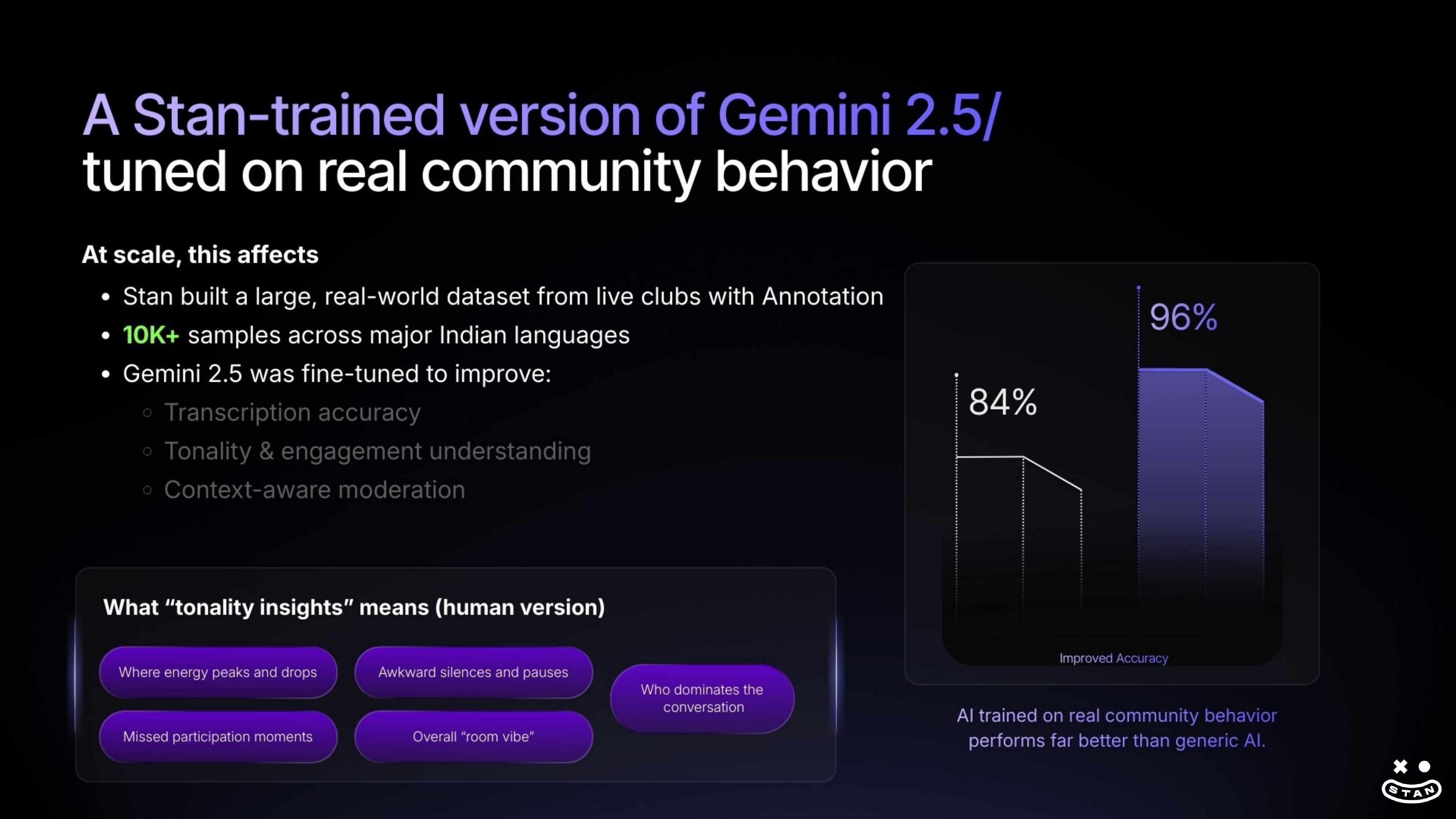
Stan-trained Gemini 2.5 improved accuracy from 84% to 96%—AI trained on real community behavior outperforms generic models
What Stan Did
Stan built a large real-world dataset from live clubs with human annotations. Over 10,000+ samples across major South Indian languages were used to fine-tune Gemini 2.5 Flash, improving transcription accuracy, tonality and engagement analysis, and context-aware moderation.
Tonality Insights
The fine-tuned model understands energy highs and lows, detects awkward silences and pauses, identifies who dominates conversations, spots missed participation opportunities, and interprets overall “room vibe.” These nuances are invisible to generic models but critical for meaningful creator feedback and accurate safety decisions.
Results
Transcription accuracy jumped from 84% to 96%a significant leap that compounds across every downstream system: better feedback, better moderation, and better user matching.
Looking Ahead
Stan’s integration with Google’s AI stack isn’t a bolt-on feature—it’s the operating system for platform quality. From the moment a creator hosts their first club to the ad creative that brings in the next million users, AI is embedded in every layer of the experience.
The playbook is clear: invest in domain-specific AI, close the feedback loops, and let the system learn from itself. For live communities, this means every session gets better, every creator gets coached, every user stays safer, and every marketing dollar works harder.